
Focus is often treated like a discipline problem. If you cannot concentrate, the assumption is that something about your habits needs to change. You need a better routine, more willpower, fewer distractions. But more often than not, the issue is not internal. It is environmental.
Small physical discomforts, poor lighting, and subtle strain on your body can quietly pull your attention away from what you are trying to do. The frustrating part is that these issues are easy to overlook because nothing feels dramatically wrong. It just feels harder than it should. The good news is that improving focus does not always require a full reset of your day. Sometimes, it comes down to fixing a few key elements in the space around you.
1. Your Lighting Is Working Against You

Lighting plays a larger role in focus than most people realize. If your workspace is too dim, your eyes work harder to process what is on the screen. If it is too harsh or poorly positioned, it can cause glare and visual fatigue. Both scenarios lead to the same outcome: your attention drifts because your brain is compensating for discomfort.
A simple desk lamp can make a noticeable difference, especially one that allows you to adjust brightness and color temperature. Cooler light tends to support alertness during focused work, while warmer tones are better suited for winding down. What matters most is control. Being able to fine-tune your lighting to match your environment and time of day removes a subtle but constant source of strain.
When choosing a lamp, it helps to look for adjustable arms, multiple brightness settings, and a wide, even spread of light rather than a narrow beam. These small features often make the difference between something that looks good on a desk and something that actually improves how it feels to work there.
2. Your Keyboard Might Be Breaking Your Flow
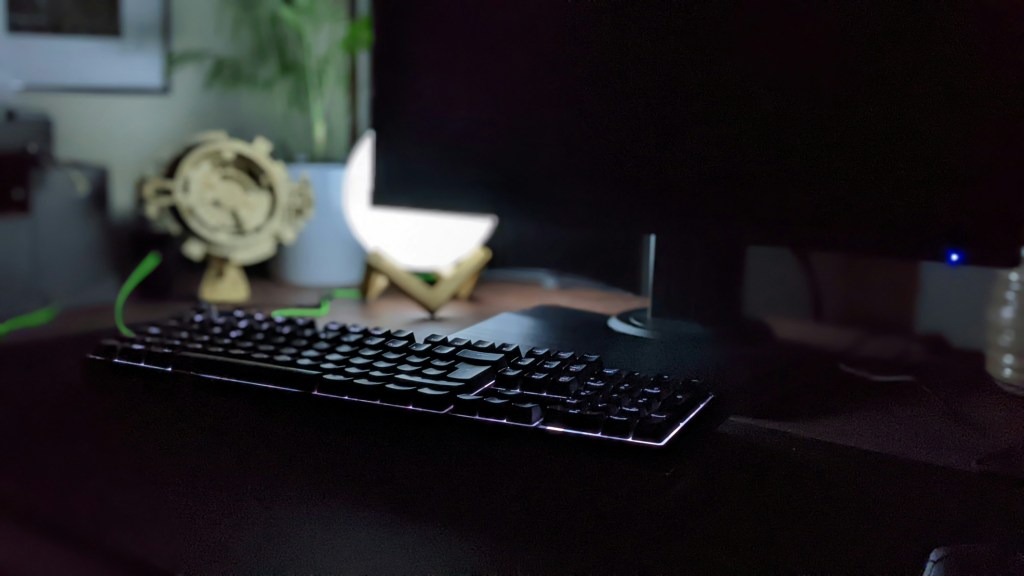
Typing should feel almost invisible. When it does not, it becomes a constant interruption. A keyboard that feels cramped, too stiff, or poorly positioned can create tension in your hands and wrists, which gradually pulls your attention away from your work.
This is where comfort becomes more than a luxury. It becomes a focus tool. Some people prefer low-profile keys that require less force, while others find that mechanical keyboards offer a more satisfying and consistent feel. There is no single “best” option, but there is a clear difference between something that supports long sessions and something that does not.
If you find yourself adjusting your hands frequently or feeling stiffness after typing, it may be worth looking into ergonomic layouts or adding a simple wrist rest. These are small changes, but they remove friction from a task you repeat constantly, which can have a noticeable impact on how long you are able to stay engaged.
3. Your Screen Setup Is Causing More Strain Than You Think

Eye strain is one of the fastest ways to lose focus, and it often builds without you noticing. If your screen is too low, too high, too bright, or positioned at the wrong distance, your eyes and neck are constantly adjusting to compensate.
Over time, this creates fatigue that feels like a lack of concentration. In reality, your body is just trying to stay comfortable.
A good starting point is screen height. The top of your monitor should sit at or slightly below eye level, allowing you to look straight ahead rather than down or up. Brightness should match the room around you rather than stand out against it. If your screen feels like the brightest object in the room, it is likely contributing to strain.
For longer work sessions, tools like monitor stands, adjustable arms, or blue light filtering settings can help create a more balanced viewing experience. These are not dramatic upgrades, but they reduce the kind of low-level discomfort that quietly drains attention over time.
4. Physical Discomfort Is More Distracting Than You Realize

It is difficult to focus when your body is constantly signaling that something feels off. A chair that does not support your posture, a desk that sits at the wrong height, or even a lack of foot support can all create small but persistent distractions.
The challenge is that these issues rarely feel urgent. You can work through them, which makes them easy to ignore. But that does not mean they are not affecting you. They are simply spreading that discomfort across hours instead of minutes.
Supportive seating, proper desk height, and even something as simple as a footrest can help stabilize your posture and reduce unnecessary movement. When your body feels settled, your attention has fewer reasons to wander.
If you are evaluating your setup, it helps to ask a simple question: can you sit and work for an extended period without needing to shift constantly? If the answer is no, there is likely an adjustment that could make a meaningful difference.
5. Your Environment Is Competing for Your Attention

Not all distractions are obvious. Background noise, inconsistent sound levels, or even a space that feels visually cluttered can make it harder to stay locked into a task.
This is where subtle control can help. For some, that means noise-canceling headphones. For others, it might be a consistent background sound that masks interruptions. The goal is not silence, but stability. When your environment becomes predictable, your brain spends less energy filtering it out.
Even small changes, like reducing visual clutter on your desk or creating a more defined workspace, can signal to your brain that this is a place for focused work. That mental association builds over time and makes it easier to settle into tasks without resistance.
Small Changes Add Up In A Big Way
Improving focus does not have to require a total overhaul of your entire routine. in actuality, removing small obstacles that make focus harder than it needs to be will result in a huge transformation for the better. Lighting, ergonomics, screen display, and environmental control are easy to dismiss because they are constants the eye passes over every day.
But that makes them essential to get exactly right. When those elements are working against you, every task is made unnecessarily harder, whether we realize it or not. What’s worse is that we are prone to not notice right away, while the harm these cause gradually snowballs. When they are working with you, however, focus, productivity, and energy can all reach their full potential.




 Daly Wordcraft
Leave a comment